
Your AI Agent Writes Code. Who's Auditing Its Commits?
A maintainer's guide to conventional-commits-framework — what it does, who it helps, and how to get started.
Your AI agent is polluting Git history.
And most developers are too busy celebrating how fast it writes code to notice.
Speed without accountability is technical debt at scale.
Look at the commits your coding agent is generating.
fix: update
feat: changes
chore: stuff
No context. No reasoning. No explicit breaking-change declaration.
Just another commit pushed into a repository someone else will have to understand six months from now.
That's not engineering velocity. That's deferred confusion.
Here's what bothers me.
We've spent years building standards around version control, semantic releases, traceability, and reproducibility.
Then we permitted AI agents to write code and quietly lowered the bar for everything around it.
Why?
Because the agent is fast?
Because the tests passed?
Because the feature works?
None of those things make an undocumented change maintainable.
A passing test doesn't explain a decision.
That's why I built the Conventional Commits Framework.
An open-source agent skill that treats Git history as an engineering artifact, not an administrative afterthought.
It establishes a consistent commit contract:
→ Atomic commits: One logical change per commit. Not a dumping ground for an entire coding session.
→ Complete context: Type, scope, subject, and body that explain what changed and why.
→ Explicit breaking changes: No guessing whether a change should trigger a major release.
→ Consistent AI attribution: One fixed Co-Authored-By trailer instead of a different identity every session.
→ Enforceable standards: Commitlint, Git hooks, CI workflows, and release tooling configuration.
And here's the part I find particularly interesting.
The framework documents format traps verified against real Git and Conventional Commits tooling.
For example, writing BREAKING CHANGE: none can actually signal a breaking change to release tooling.
Think about that.
Your agent could be trying to say "nothing broke" while telling your release pipeline the exact opposite.
The syntax is valid. The consequence is wrong.
That's the kind of problem you don't solve by asking an AI agent to "write better commit messages."
You solve it with a repeatable system.
The framework is available through the Skills CLI:
npx skills add YourAKShaw/conventional-commits-framework
It also documents direct installation for Claude Code and Claude apps, with Skills CLI support for compatible agent runtimes.
It's now listed in the Awesome AI Plugins registry.
Registry: https://hol.org/registry/plugins/yourakshaw%2Fconventional-commits-framework
Source: https://github.com/YourAKShaw/conventional-commits-framework
Open source. MIT licensed.
If you build something with it, tell me what worked, what broke, and what you'd improve.
I'd rather hear about one real implementation than collect a hundred meaningless stars.
Because here's where I stand:
AI should reduce engineering work, not erase engineering discipline.
And if we're going to let agents write more of our software, we should be raising our standards.
Not negotiating them downward.
Curious how other engineering teams are handling this:
Do you enforce commit standards on AI-generated changes, or are you still trusting the agent to get them right?
#AIAgents #DeveloperTools #SoftwareEngineering #OpenSource
Continue reading
All postsWhat I Check Before I Install a Claude Plugin on a Client's Computer
A Claude consultant's pre-install checklist for small businesses: who made it, what it tells Claude to do, what it runs, what it touches, what Claude finds when it reviews it, where it gets tested, and who keeps track.
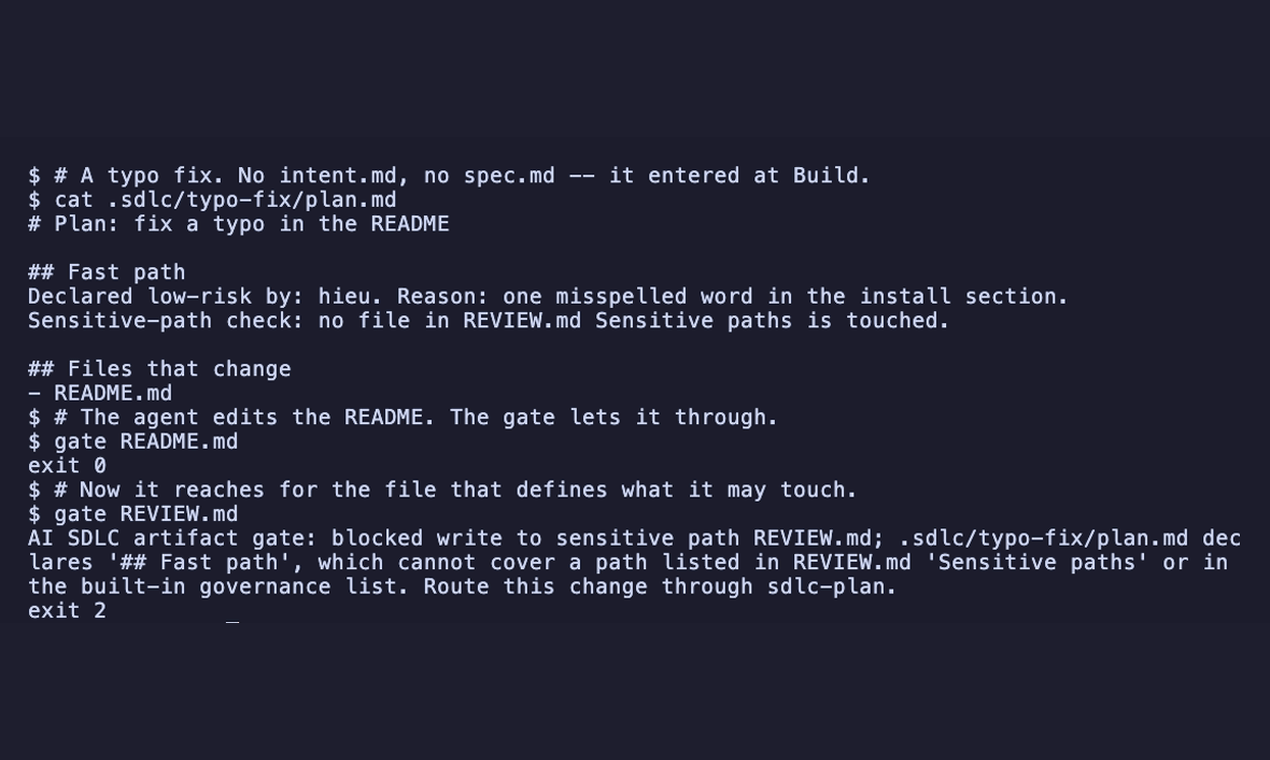
A declaration buys fewer stages, never fewer boundaries
The ai-native-sdlc plugin packages six stages as committed Markdown artifacts and uses an opt-in PreToolUse gate to block uncovered source-code writes.
VibesPlug's README lists 155 agents and supported coding tools
The project README lists 155 specialized subagents, supported coding tools, npm setup commands and a standalone MCP server.