On this page
AI coding agents are getting remarkably good at writing software.
And that's exactly why I'm becoming increasingly concerned about how we're using them.
We have agents that can generate entire applications, design APIs, refactor codebases, write tests, and deploy services.
Give them a sufficiently detailed prompt, and they'll produce hundreds of lines of seemingly production-ready code in minutes.
But here's the question I keep coming back to:
Who's thinking about what happens when that code fails?
Not when the syntax is wrong.
Not when a unit test fails.
When everything appears to work, the tests are green, the deployment succeeds, and the system breaks three weeks later under conditions nobody bothered to consider.
That's where software engineering begins to separate itself from code generation.
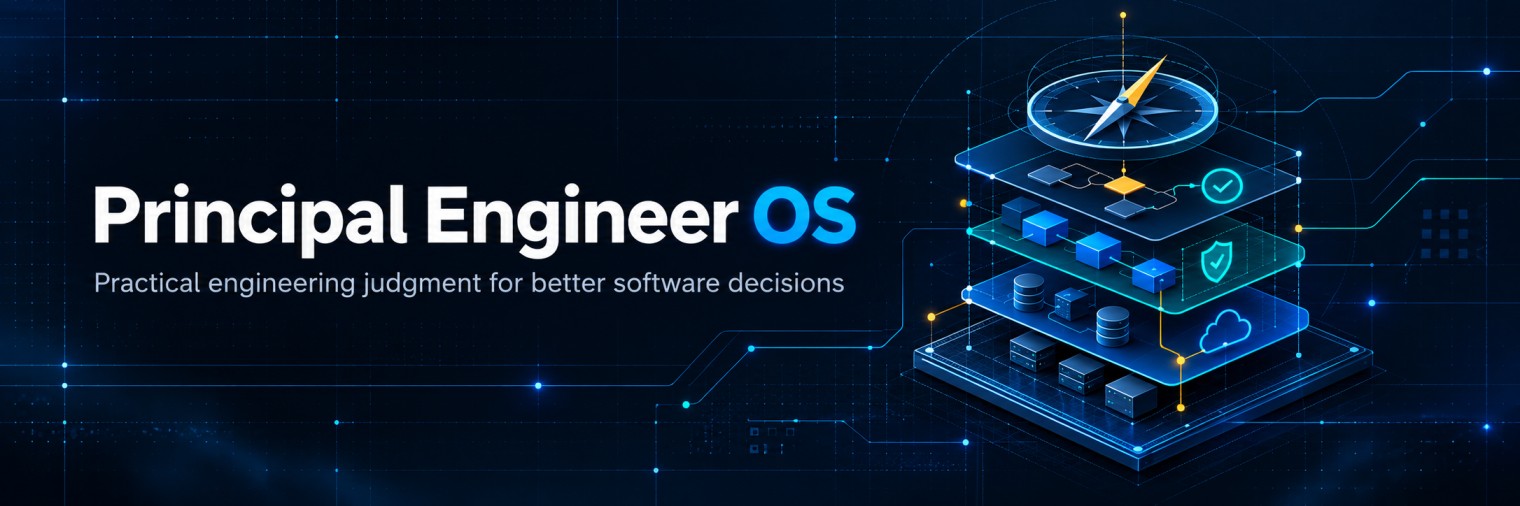
And that's why I built Principal Engineer OS (PEOS).
An open-source agent skill designed to bring principal-engineer judgment into AI-assisted software development.
Not to make AI agents write more code.
To make them reason more carefully about the code they're already writing.
The Problem Isn't That AI Writes Bad Code
It's that AI can write perfectly reasonable code for the wrong engineering decision.
Consider a simple payment API.
You ask your coding agent to implement an endpoint that charges a customer.
It writes the controller, integrates the payment provider, handles the response, adds validation, and generates tests.
Everything passes.
The feature works.
You ship it.
Now imagine the payment provider processes a charge, but your application times out before receiving the confirmation.
The client retries.
Your endpoint processes the request again.
The customer gets charged twice.
The code wasn't necessarily broken.
The engineering assumptions were incomplete.
Nobody established an idempotency contract.
Nobody modeled the uncertain outcome.
Nobody considered how reconciliation would work when the provider and your database disagreed.
And nobody asked what recovery would look like after the damage was already done.
This isn't a problem you solve by telling an agent to "write cleaner code."
It's a problem of engineering judgment.
The same pattern appears everywhere.
An authenticated API that forgets tenant-level authorization.
A database migration that works locally but breaks an older worker still running in production.
A retry mechanism that accidentally multiplies side effects.
A caching strategy that improves latency while serving stale authorization decisions.
A rollback procedure that becomes unsafe after new data has been written.
All of these systems can look correct in a pull request.
Until reality introduces the conditions the implementation never considered.
Working code is not the same thing as a defensible engineering solution.
We've Automated Implementation Faster Than We've Automated Judgment
Here's what bothers me about the current direction of AI-assisted development.
We keep measuring how much code an agent can generate.
How quickly it can complete a task.
How many issues it can resolve.
How many benchmarks it can pass.
Those measurements have value.
But they don't tell us whether the agent made the right architectural trade-offs.
They don't tell us whether the implementation respects the system's security boundaries.
They don't tell us whether the migration is reversible.
They don't tell us whether the service will remain maintainable six months from now.
And they certainly don't tell us whether the person responsible for operating that software understands its failure modes.
We've spent decades developing engineering disciplines around these problems.
Architecture reviews.
Threat modeling.
Failure analysis.
Incremental migrations.
Observability.
Incident response.
Operational readiness.
Then AI coding agents arrived, and somewhere along the way, we started treating successful code generation as evidence of successful engineering.
Why?
Because the agent completed the task?
Because the tests passed?
Because the application runs?
None of those things automatically establish that the system is safe to operate.
And the faster we generate software, the more consequential that distinction becomes.
Introducing Principal Engineer OS
Principal Engineer OS is my attempt to address that gap.
It's a reusable, open-source agent skill that provides AI coding agents with a structured engineering constitution, focused workflows, domain-specific guidance, and repeatable decision-making practices.
The objective is straightforward:
Deliver the smallest defensible solution that meets the requested outcome, protects its invariants, and remains affordable to operate and evolve.
That principle matters more than it might initially appear.
Because principal-engineer judgment isn't about making every task complicated.
It's about understanding which tasks deserve complexity and which don't.
A documentation typo doesn't need an architectural review.
A contained utility change shouldn't require an elaborate design document.
But an authentication redesign, a payment integration, or an irreversible database migration?
Those deserve significantly more scrutiny.
PEOS is designed around that distinction.
It brings engineering discipline into seven workflows:
- System Design: Evaluate constraints, alternatives, boundaries, failure modes, and architectural trade-offs before committing to an implementation.
- Repository Bootstrap: Establish a working foundation with reproducible development workflows and a functional vertical slice.
- Feature Implementation: Deliver focused changes while examining correctness, compatibility, security, and operational consequences.
- Code Review: Identify consequential defects, prioritize findings, and support recommendations with actual evidence.
- Refactoring and Debugging: Diagnose problems systematically, preserve existing behavior, and measure improvements rather than guessing.
- Production Readiness: Evaluate deployment risks, observability, recovery procedures, and release-specific evidence.
- Incident Response: Support controlled stabilization, investigation, recovery, and follow-up without confusing recommendations with authorization.
The idea isn't to make an agent pretend to be a principal engineer.
It's to give the agent a repeatable system for applying the kinds of questions experienced engineers know they must ask.
One of My Favorite Design Decisions: Effort Should Follow Risk
There's a trap in building engineering frameworks.
You can make them so comprehensive that they become impractical.
Every change triggers another checklist.
Every implementation requires another document.
Every decision turns into an architectural debate.
Eventually, the framework becomes an obstacle to the work it was supposed to improve.
I didn't want that.
So PEOS uses five risk tiers, from R0 to R4.
R0 — Minimal risk
Comments, typos, documentation formatting, and similarly contained changes.
Inspect the context. Make the focused change. Verify the diff.
R1 — Low risk
Contained utilities, noncritical UI changes, and localized behavior.
Verify the intended behavior and relevant edge cases.
R2 — Moderate risk
Endpoints, queries, integrations, background workers, and changes that cross meaningful system boundaries.
Examine failure conditions, compatibility, and the assumptions surrounding those boundaries.
R3 — High risk
Authentication, payments, sensitive data, concurrency, and consequential migrations.
Apply deeper security analysis, correctness checks, rollout planning, and recovery considerations.
R4 — Critical risk
Production deletion, irreversible migrations, and privilege architecture changes.
Require explicit authorization, appropriate sign-off, staged execution, and rehearsed recovery where applicable.
And here's an important detail.
Risk isn't determined by how many lines of code changed.
A three-line authorization mistake can be more dangerous than a thousand-line UI refactor.
A single database statement can create consequences that are difficult or impossible to reverse.
The framework makes engineering effort proportional to potential consequences, not the visual size of a pull request.
That's a distinction I believe AI coding agents need to understand.
The Most Important Engineering Decisions Happen at Boundaries
When I think about production systems, I rarely start by asking whether the code looks elegant.
I start by looking for the boundaries.
Where does trusted identity enter the system?
Where is authorization enforced?
What happens when two requests modify the same resource?
What happens when an external dependency succeeds but the local operation fails?
What assumptions exist between application versions during a deployment?
What happens when a process crashes halfway through an operation?
Those boundaries are where otherwise reasonable implementations tend to become dangerous.
Principal Engineer OS explicitly directs attention toward them.
It encourages agents to distinguish between the happy path and the actual operating conditions of the system.
To examine retries, concurrency, transactions, partial failures, and recovery.
To question whether a proposed abstraction is justified.
To consider the operational cost of a design rather than treating infrastructure as free.
And to make uncertainty visible instead of hiding it behind confident language.
Because a system doesn't become reliable simply because its components are individually correct.
Reliability emerges from how those components behave when their assumptions stop holding.
Another Principle: Don't Confuse Confidence With Evidence
This is one of the biggest problems I see with AI-generated engineering work.
An agent finishes a task and confidently reports:
"Implementation complete. Everything is working."
But what does that actually mean?
Did it run the tests?
Did it inspect the affected dependencies?
Did it verify the database migration?
Did it examine the deployment environment?
Or did it simply generate code that appears reasonable?
Those are very different levels of evidence.
PEOS emphasizes separating:
- What the agent actually inspected.
- What it changed.
- What checks it executed.
- What the results demonstrate.
- What assumptions remain unverified.
- What risks or limitations still exist.
If a test wasn't executed, the agent shouldn't imply that it passed.
If production behavior wasn't observed, the agent shouldn't claim production readiness.
If a proposed recovery procedure hasn't been rehearsed, it shouldn't be described as proven.
This isn't about making AI agents less useful.
It's about making their outputs more trustworthy.
An engineer who can explain what they don't know is more useful than an agent that confidently invents certainty.
That applies to humans, too.
Good Architecture Isn't the Most Sophisticated Architecture
There's another failure mode I wanted PEOS to resist.
Overengineering.
AI agents can be remarkably enthusiastic about introducing abstractions.
Ask for a small service, and you might receive an elaborate architecture with multiple layers, factories, interfaces, event buses, and enough configuration to make a simple feature look like a distributed systems research project.
Sometimes those patterns are justified.
Often they aren't.
A principal engineer should be able to defend complexity in terms of actual requirements.
What problem does this abstraction solve?
What happens if we don't introduce it?
What operational burden does it create?
Does the team have the capacity to maintain it?
Can we achieve the same outcome with fewer moving parts?
The framework encourages agents to compare credible alternatives and explain why a particular approach deserves to exist.
Because every abstraction has a cost.
Every dependency creates another failure surface.
Every additional service introduces operational responsibilities.
And every architectural decision constrains what becomes easy or difficult in the future.
The goal isn't to build the most impressive system. It's to build the simplest system that can responsibly meet its obligations.
That's a much harder standard than generating sophisticated-looking code.
How Principal Engineer OS Works
PEOS isn't a new language model, an autonomous production operator, or a replacement for engineering leadership.
It's an agent skill.
It provides structured instructions and supporting resources that compatible AI agents can use during engineering tasks.
The process follows a practical sequence:
1. Understand the requested outcome and repository context.
Before proposing a solution, establish what needs to change and what constraints already exist.
2. Apply the engineering constitution and assess risk.
Identify the relevant correctness, security, maintainability, operational, and recovery considerations.
3. Select the appropriate workflow and domain guidance.
Use the material relevant to the task rather than loading every possible engineering checklist.
4. Perform focused engineering work.
Design, implement, review, investigate, or prepare the requested change according to its actual scope.
5. Verify the result.
Gather evidence appropriate to the risk, distinguish executed checks from assumptions, and identify unresolved issues.
6. Produce a clear handoff.
Communicate what changed, why it changed, what was verified, and what still requires attention.
That last step matters.
Because software engineering isn't complete when the agent stops generating tokens.
Someone still needs to understand the result.
Someone still needs to maintain the system.
And when something fails, someone needs enough context to make the next decision responsibly.
Getting Started
Principal Engineer OS is open source and available on GitHub.
Repository: https://github.com/YourAKShaw/principal-engineer-os
Skills directory: https://www.skills.sh/yourakshaw/principal-engineer-os/principal-engineer-os
For a personal Claude Code installation, clone the complete skill into your local skills directory:
mkdir -p ~/.claude/skills

git clone https://github.com/YourAKShaw/principal-engineer-os.git \
  ~/.claude/skills/principal-engineer-os
For a project-specific installation, use .claude/skills/principal-engineer-os inside the project instead.
Once installed, you can invoke it directly in Claude Code:
/principal-engineer-os Review this repository's authorization boundaries and report evidence-backed findings.Or apply it to a consequential engineering decision:
/principal-engineer-os Evaluate the failure modes, idempotency requirements, and recovery strategy for this payment integration.The repository includes the engineering constitution, seven workflows, supporting references, and reusable resources.
It's MIT licensed.
And it's intended to be inspected, challenged, improved, and adapted by the engineering community.
One important qualification: a skill can improve the structure of an agent's reasoning, but it cannot guarantee correctness, security, or production readiness. Those outcomes still depend on the underlying model, tools, repository context, available evidence, and human oversight.
Why I Open-Sourced It
I build software, work with AI coding agents, and spend a considerable amount of time thinking about how engineering workflows are changing.
And I keep returning to the same conclusion.
The next major improvement in AI-assisted development shouldn't just be about generating code faster.
It should be about making better engineering decisions with less wasted effort.
I don't want an agent that automatically agrees with my proposed architecture.
I want one that can identify a missing constraint.
Challenge an unjustified abstraction.
Surface a security boundary I overlooked.
Explain why a migration strategy is unsafe.
And tell me when the available evidence isn't sufficient to make a responsible decision.
That's the kind of engineering assistance I find valuable.
It's also why I wanted the framework to be open source.
Engineering judgment improves through criticism, real-world failures, competing perspectives, and practical experience.
No single document can capture every production scenario.
No framework can replace domain expertise.
And no AI agent should be granted authority simply because its output sounds convincing.
But we can establish better defaults.
We can make important questions harder to ignore.
We can create repeatable practices that encourage agents to examine consequences before producing implementations.
And we can improve those practices through real-world use.
If you try Principal Engineer OS, I'd genuinely like to know where it helps, where it gets in the way, and which engineering situations it handles poorly.
Especially the difficult ones.
I'd rather discover a flaw in the framework through a thoughtful issue than collect a hundred stars from people who never tested it.
The Standard Should Rise With the Capability
AI is changing how software gets built.
I don't think there's much value in pretending otherwise.
Coding agents will become more capable.
They'll handle larger tasks.
They'll operate across more systems.
And they'll increasingly participate in decisions that used to require substantial human effort.
But increased capability shouldn't mean reduced accountability.
Quite the opposite.
The more responsibility we delegate to AI, the stronger our engineering standards need to become.
A faster implementation doesn't excuse an unsafe migration.
A passing test doesn't establish architectural correctness.
A working feature doesn't eliminate operational risk.
And an impressive demonstration doesn't prove a system is ready for production.
That's the philosophy behind Principal Engineer OS.
Not AI replacing engineering judgment.
AI being held to a more disciplined engineering process.
Because the future of software development shouldn't be about how quickly we can generate code nobody fully understands.
It should be about how effectively we can build systems that remain correct, secure, maintainable, and recoverable when the real world stops cooperating.
AI should accelerate engineering. Not lower the standard of what engineering means.
And if we're going to trust agents with increasingly consequential software, we should start by teaching them to ask better questions.
Not just write faster answers.
Explore Principal Engineer OS: https://github.com/YourAKShaw/principal-engineer-os
I'm curious how other engineers and teams are approaching this:
Are you explicitly enforcing architectural and production-readiness standards in your AI coding workflows, or are you still relying on the agent to make those decisions on its own?
#AIAgents #SoftwareEngineering #SystemDesign #OpenSource