
DARE: De Anthropocentric Research Engine
DARE is a research skill library for AI agents. Not a tool that helps an agent do research — the research procedure itself, written down in a form an agent can execute.
Contents
DARE is a research skill library for AI agents. Not a tool that helps an agent do research — the research procedure itself, written down in a form an agent can execute.
What it does
271 Markdown files: 51 research tactics, 216 single-purpose SOPs, and four product shells. The tactics cover literature synthesis, gap validation, hypothesis formation, experiment design, result interpretation, red-teaming, analogy, and structured consensus.
You give it a research direction in plain language. It crystallizes that into a North Star and a research brief, drafts a staged Research Spec, and waits for your approval. Nothing runs before you approve the Spec. Execution then proceeds phase by phase, appending a checkpoint after each step, so an interrupted run resumes from the last complete one instead of starting over.
Two properties make it different from the research agents already out there.
Every step states what its output must contain, what condition proves it is finished, and what its output looks like when the work did not hold. An empty result is not completion. Elapsed time is not completion. A gap that turned out to be an artifact of how the evidence was gathered is reported as an artifact, not as a finding.
And it is not a pipeline. Fixed-stage research systems run literature → hypotheses → experiments in order, and their backtracking means retrying the current step. DARE walks back: when the evidence base turns out too thin to support the experiment it is designing, it returns to the literature. The sequence lives in a Spec you approved, and that Spec records the conditions under which the sequence should be abandoned.
Who it helps
Researchers who want the literature work, the gap validation, and the falsifiability checks done systematically rather than improvised — and who want to be able to read, afterwards, why the agent concluded what it did.
Agents that need a procedure they can execute rather than a prompt they can interpret. DARE is decoupled from retrieval: across all 271 files there is no MCP server name, no tool name, no API key. Retrieve with whatever your agent already has and hand the results in. Swapping providers needs no skill edit.
Teams that want an auditable record. Checkpoints append and are never edited; a plan change is a new decision event, so the reasoning behind the current plan stays readable after the plan itself moves on.
How to get started
npx skills add yogsoth-ai/de-anthropocentric-research-engine --skill '*'Run it from your own project directory. --skill '*' takes the whole graph — a partial install breaks call edges, since a tactic that loads a missing step has no fallback.
Then invoke the entry skill: /de-anthropocentric-research-engine, give it a research direction. You will get a North Star, a brief, and a Spec to approve.
If you would rather not commit to a plan upfront, /research-catalog exposes the 51 tactics as a toolbox: the agent plans its own route and loads whichever tactics fit. You give up the approval step and the checkpoint log, and an interrupted run does not resume.
\\## Where to find it
Registry: https://hol.org/registry/plugins/yogsoth-ai%2Fde-anthropocentric-research-engine
Source: https://github.com/yogsoth-ai/de-anthropocentric-research-engine
Apache-2.0. No runtime, no build step, no API key. If you build something with it, tell me — a maintainer's guide is only useful if it says what actually happened when someone used it.
Continue reading
All postsWhat I Check Before I Install a Claude Plugin on a Client's Computer
A Claude consultant's pre-install checklist for small businesses: who made it, what it tells Claude to do, what it runs, what it touches, what Claude finds when it reviews it, where it gets tested, and who keeps track.

Your AI Agent Writes Code. Who's Auditing Its Commits?
A maintainer's guide to conventional-commits-framework — what it does, who it helps, and how to get started.
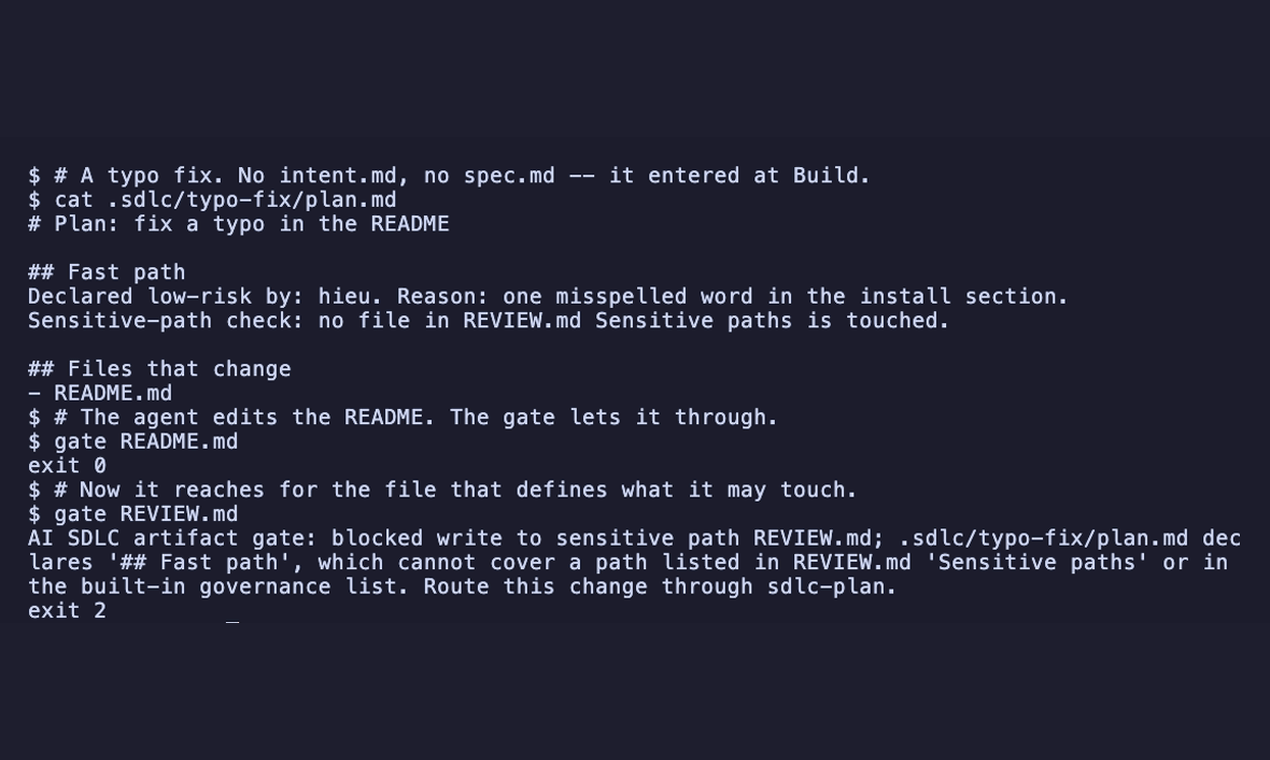
A declaration buys fewer stages, never fewer boundaries
The ai-native-sdlc plugin packages six stages as committed Markdown artifacts and uses an opt-in PreToolUse gate to block uncovered source-code writes.